Coordination and Coherence in EU Local Capacity Building
EU capacity-building efforts operate in a crowded institutional landscape where coordination failures undermine impact, making coherence across international and local actors the central challenge for effective peacebuilding.
Written by Gilberto Algar-Faria, Ana E. Juncos, Timothy Edmunds, Sonja Stojanović Gajić, Katarina Đokić, Erik Plänitz, Khadir Abdi and Savannah Simons
Capacity building is often conceived as a holistic activity. It comprises activities that take place across a range of policy spheres to contribute to wider peacebuilding and conflict prevention efforts in target countries. It is also an internationalised practice, with multiple actors and organisations engaged in different projects with a range of local interlocutors and institutions. In consequence, capacity building tends to take place in a complex institutional space, involving multiple actors, projects, relationships and partners. Such complexity implies a need for coordination at the operational level to avoid duplication of effort and encourage complementarity and coherence in delivery. However, it also presents a series of challenges.
The EU has recognised the importance of, and difficulties related to, increasing coordination and coherence in its actions. For example, the EU’s Global Strategy puts forward a positive intention for the EU’s external action to “become more joined up”.[1] The EU has also invested a lot of efforts in developing a comprehensive approach among its different components and instruments.[2] In its Global Strategy, the EU highlights the need to develop an integrated response to conflicts and crises, expanding the comprehensive approach further.
Deliverable 6.2 focuses particularly on coordination and coherence between international actors and local actors in the context of the implementation of local capacity building programmes in the Western Balkans and the Horn of Africa. While problems related to a lack of coherence have impinged upon the efforts of every international organisation and country involved in capacity building, in the case of large international organisations like the EU, internal coherence represents a specific challenge. Different factors explain why ensuring coherence is such a difficult task: these include foremost the complexity of financial and decision-making procedures and the number and diversity of actors involved in both the decision-making and the implementation process. If capacity building at the international level is complex, so too are the local political environments in which it takes place. This is visible at the policy level, between the different institutions, organisations and actors of government. However, it is also likely to include variegated configurations of political power and interest within the country concerned, as well as distinctions such as those between regions, or between political elites and civil society.
Therefore, Deliverable 6.2 addresses the following guiding question:
How can the EU and other international actors best coordinate their local capacity building initiatives?
The challenges identified in DL 6.2 centre on the capacity of international actors to coordinate in such a way as to promote horizontal, vertical and inter-institutional coherence. Still, for any hope of coherence, a lead coordinator must be designated, and in the cases highlighted in this report it is clear that EU Delegations can play this role when it comes to coordinating EU actors. Coordinating across a complex range of actors and projects is difficult. Few international capacity building programmes take place under the auspices of a single directing authority, able to plan and integrate activities from the top, though in some cases there may be a lead organisation tasked with a coordination and deconfliction role. This latter approach has been demonstrated to be more effective, particularly in the case of Kosovo. Even in the case of a single entity such as an international organisation, state or government department, coordinating multiple capacity building projects or coordinating between the centre and the field can be challenging. Such challenges often manifest as technical problems – of sequencing, duplication and deconfliction, for example.
Given the above discussion, EU-CIVCAP’s research identified seven key policy recommendations:
- Designate a responsible coordinator. Any coordination effort requires a responsible coordinator to be designated if it is to be effective. The coordinator also stores and provides corporate knowledge. Without a clearly defined coordinator, it is highly unlikely that any international capacity building approaches will be coherent.
- Establish a ‘rule of law’ team in the EU Delegation to ensure intra-EU coordination. This creates a single point of contact for all EU components, allowing Brussels-based institutions to devolve more responsibility to Delegations, and enabling Delegations to extend their work regionally while providing policy advice to Brussels, facilitating better learning.
- Avoid ad hocism in coordination mechanisms. Ad hocism can lead to last-minute reactive decision-making and conflicting approaches that are more damaging than they are mutually supportive. This can be achieved through the design and implementation, along with awareness raising at all levels, of long-term planning mechanisms, standard operating procedures and decision-making responsibilities.
- Ensure mandates are flexible. Flexible mandates allow for the adaptation of priorities and missions on the part of internationals, allowing them to react effectively to rapidly changing situations, and preventing the duplication and/or overlapping of international actors’ programmes. This can be achieved by downsizing missions and decentralising responsibility for achieving objectives (see recommendation 7).
- Specify a long lead-in time for, and promote transparency in, the project formulation process, and begin coordination at the project design stage. Local interviewees suggested that projects were presented to the donors shortly before those projects were launched. Effective coordination should commence simultaneously with the start of the project planning process to mitigate the risk of duplicating spending, to avoid starting a race among the donors to form local partnerships, and to ensure coherence among donor organisations’ approaches.
- Engage the smaller, less prominent actors, address local needs and avoid duplication. Programmes should begin with a comprehensive local needs assessment, but this assessment must take into account not only local needs but also what is already being done by other entities to address those needs.
- Create a ‘circle of champions’. Among local partners, individuals may be selected to assist with both the dissemination and assimilation of particular internationally-led initiatives within their networks. This also allows for better situation of coordination within the specificities of the local context.
References
[1] European External Action Service (EEAS). (2016). Shared vision, common action: A stronger Europe – A global strategy for the European Union’s foreign and security policy. https://eeas.europa.eu/archives/docs/top_stories/pdf/eugs_review_web.pdf
[2] European Commission. (2013). The EU’s comprehensive approach to external conflict and crises (JOIN(2013) 30 final). High Representative of the European Union for Foreign Affairs and Security Policy. http://www.eeas.europa.eu/archives/docs/statements/docs/2013/131211_03_en.pdf; Faleg, G., Pirozzi, N., Venturi, B., & Habbida, N. (2018). Report on EU comprehensive approach to conflict prevention and peacebuilding (EU-CIVCAP Deliverable 4.3). https://eucivcap.wordpress.com/wp-content/uploads/2018/03/eu-civcap_deliverable_4-3.pdf; de Coning, C., & Friis, K. (2011). Coherence and coordination: The limits of the comprehensive approach. Journal of International Peacekeeping, 15(1–2), 243–272. https://doi.org/10.1163/187541110X540553
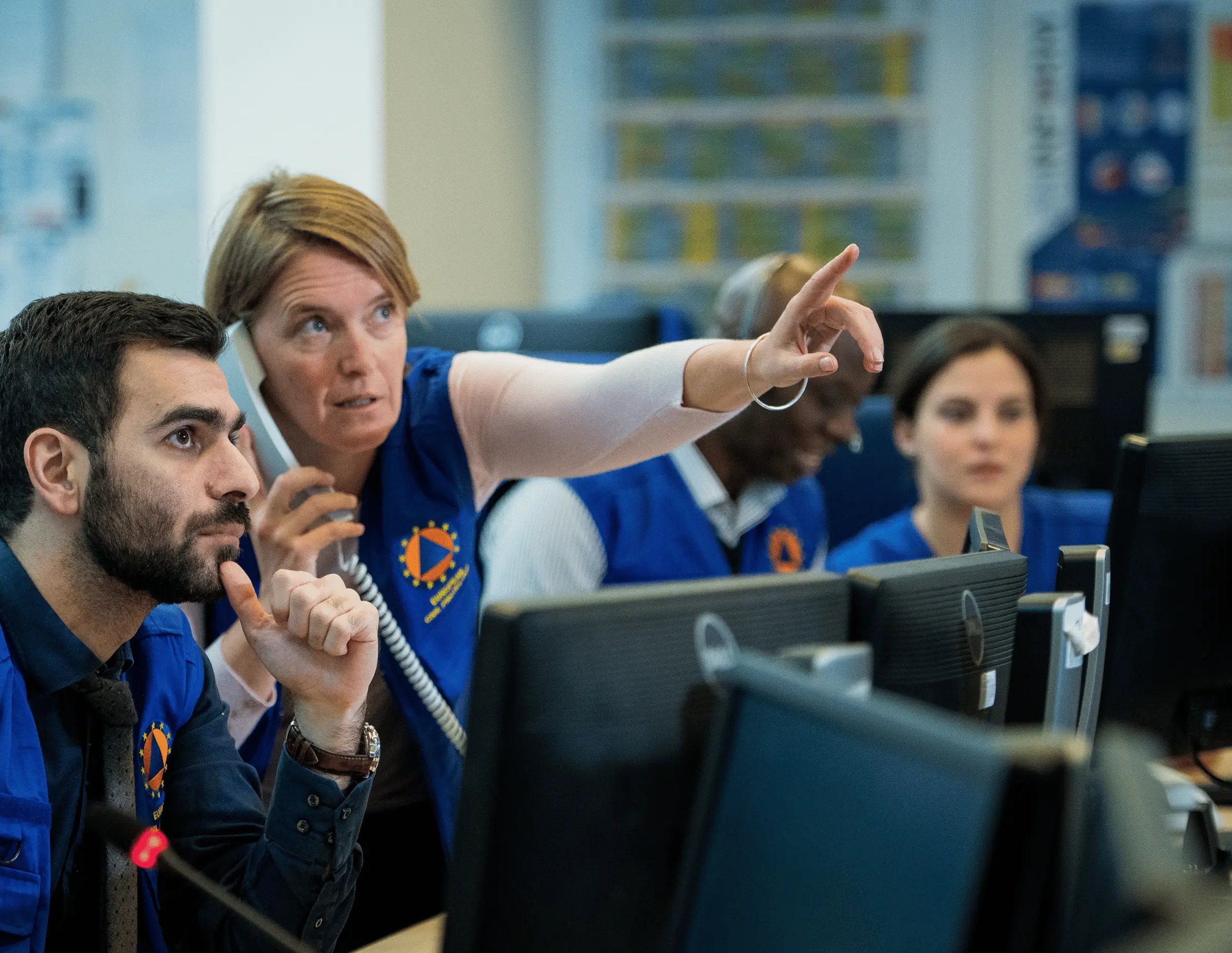
Cover photo: Working environment at the Emergency Response Coordination Centre (ERCC). Credit: EC Photo/Ezequiel Scagnetti